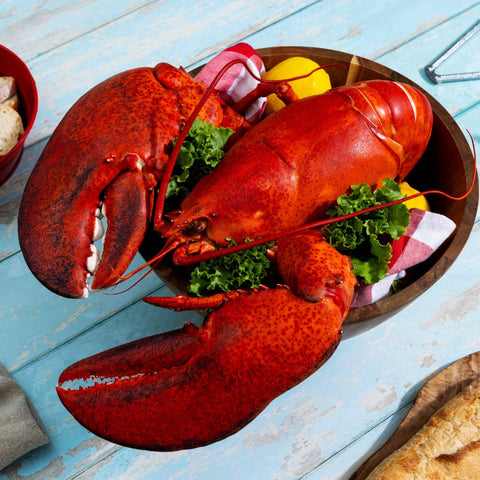
There is more to Maine lobster than the tail on the plate. Understanding the animal also helps explain why whole lobsters, tails, and Maine style lobster rolls offer different eating experiences. Here are useful facts without the folklore.
Anatomy and life in the ocean
- A species name: the American lobster is Homarus americanus.
- Two different claws: a crusher breaks hard food; a finer-edged claw tears it.
- Ten legs: the front pair bears the large claws.
- A different color when alive: most are greenish-brown rather than the familiar cooked red.
- A shell that must be replaced: lobsters molt to grow.
- Recycling after molting: they may eat their shed shell to recover calcium.
- Eggs carried outside the body: females carry eggs beneath the tail until hatching.
- Age is difficult to establish: size alone cannot give an exact birthday.
Source: NOAA American lobster biology. Reviewed September 22, 2026.
Three common misconceptions
“Lobsters cannot feel pain”
That is too confident. A scientific review commissioned by the UK government found evidence supporting sentience in decapod crustaceans, including lobsters. The absence of a human-style brain structure does not establish an inability to experience pain. Handling discussions should reflect the evidence and its limits.
Source: London School of Economics review of decapod sentience. Reviewed September 22, 2026.
“Lobsters are immortal”
Lobsters are not immortal. Long life and unusual growth patterns do not make an animal immune to aging, disease, predation, or the demands of molting. Exact ages of exceptionally large animals are difficult to establish, so treat precise age claims cautiously.
“Soft-shell lobster is a different species”
Soft-shell lobsters are lobsters with a newer shell after molting. Shell condition changes the cracking experience and can affect how full the shell is. It does not turn an American lobster into a different species.
What these facts mean at the table
Whole-lobster weight includes the shell and other parts you will not serve as picked meat. Tail weight also includes shell. When a recipe specifies a weight of cooked lobster meat, do not replace it with the same weight of whole lobster and expect the same yield.
The finished dish’s nutrition depends on the serving and preparation. A plain lobster portion, a butter-rich pasta, and a dressed lobster roll are different meals. Use the ingredient labels and the actual recipe rather than assuming every lobster dish has the same nutrition.
Choose the lobster dinner you want
Before you order a lobster from Maine Lobster Now, decide whether you want the experience of cracking a whole lobster or the simpler portion planning of lobster tails or picked meat. For a casual meal, delicious Maine lobster rolls put the focus on the filling and a toasted bun. Check the current package and preparation directions for whichever format you choose.